When a small business owner types “accountant near me” at 11 PM after struggling with QuickBooks for hours, they’re not looking for stock photos of calculators or generic promises about tax savings. They’re looking for rescue. The elements that make a CPA website truly effective aren’t what most accounting firms think. While your competitors fill their sites with industry jargon and bland service lists, the firms winning new clients understand that a website must bridge the gap between technical expertise and human reassurance.
The difference between a CPA website that generates consistent leads and one that sits dormant isn’t about flashy design tricks or following every digital marketing trend. It’s about understanding the emotional state of potential clients when they land on your site, often confused, sometimes desperate, and always hoping to find a professional who can translate financial complexity into clarity. The most successful accounting websites balance technical credibility with accessibility, creating digital experiences that feel like sitting across from a trusted advisor rather than staring at a corporate brochure.
This comprehensive guide examines the critical elements that transform ordinary accounting websites into client-generating assets. From strategic content architecture to conversion psychology, we’ll explore how forward-thinking CPA firms are reimagining their online presence to connect with clients who increasingly make their professional service decisions based on digital first impressions.
TL;DR
- A successful CPA website must bridge trust and usability, not just list services.
- Professional design, mobile responsiveness, and intuitive navigation establish credibility fast.
- Clear value messaging and industry-specific content show expertise and relatability.
- Trust elements like testimonials and certifications reduce hesitation and build confidence.
- High-performing sites use conversion features, CTAs, scheduling tools, and easy forms, to turn visitors into clients.
- SEO and local optimization ensure your site ranks when people search “accountant near me.”
- Secure client portals and interactive tools improve client experience and demonstrate tech-savviness.
- Ongoing analysis via Google Analytics helps you refine performance based on user behavior.
Features of High-Converting vs. Average CPA Websites
| Feature | High-Converting CPA Website | Average CPA Website |
| Design & Visuals | Clean, modern, branded design | Generic template with stock photos |
| Mobile Experience | Fully responsive, designed mobile-first | Poor mobile adaptation or desktop-only design |
| Content Clarity | Clear, jargon-free messaging that speaks to client needs | Vague service descriptions with industry jargon |
| Trust Signals | Prominently displayed testimonials, case studies, certifications | Few or hidden trust indicators |
| Calls to Action (CTAs) | Action-driven CTAs on every key page | Limited CTAs, often just one “Contact Us” button |
| Contact Options | Multiple methods: form, phone, email, live chat, scheduling tool | Single email or generic contact form |
| Client Portals & Tools | Secure login, downloadable guides, financial calculators | Basic forms or no client resources |
| SEO Optimization | Local keywords, fast loading, schema markup, content strategy in place | No metadata, poor speed, little or outdated content |
Professional Design for Accounting Websites in Making the Right First Impression
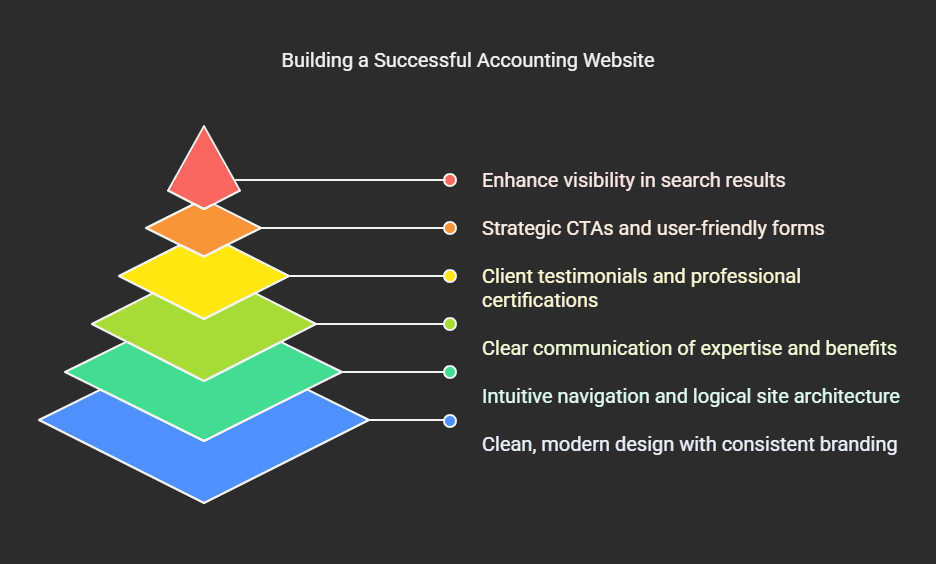
The visual appeal of your accounting website design plays a crucial role in establishing trust with website visitors. Modern accounting firm websites feature clean, professional designs with consistent branding throughout the entire site. This includes thoughtful color schemes, professional typography, and high-quality imagery that reflects the firm’s identity and values. A sleek website design effectively showcases the firm’s professionalism, enhancing the perceived reliability and relevance of your business.
A well-designed website for a CPA firm should balance sophistication with approachability. The layout should be uncluttered, making it easy for potential clients to find the information they need without feeling overwhelmed. Remember that your website design directly communicates your firm’s professionalism and attention to detail qualities that are particularly important in the accounting industry.
Mobile responsiveness is non-negotiable for successful accounting websites. With more than half of all web traffic coming from mobile devices, your site must function flawlessly across all screen sizes. This mobile-first approach ensures that prospective customers can access your services pages and contact details whether they’re at their desk or on the go.
Related: Web Design Mistakes
User Experience For Creating Intuitive Navigation
The best accountant websites prioritize user experience through intuitive navigation and logical site architecture. Enhancing user experience with intuitive navigation is crucial as it helps attract new clients and improves search engine rankings. When prospective clients visit your site, they should be able to find exactly what they’re looking for within seconds.
Navigation best practices for accounting websites include:
- Clear, descriptive menu labels (avoid industry jargon)
- Logical grouping of related services
- Prominent contact information on every page
- Search functionality for larger sites
Page load speed is another critical factor that affects both user experience and search engine rankings. Slow-loading pages frustrate visitors and increase bounce rates. Optimize images, leverage browser caching, and consider using a content delivery network (CDN) to enhance your site’s performance and create a positive user experience.
Accessibility features should also be incorporated to ensure your website serves all users, including those with disabilities. This includes proper heading structures, alt text for images, keyboard navigation options, and sufficient color contrast. Not only does this broaden your potential client base, but it also demonstrates your firm’s commitment to inclusivity.
Essential Content: Communicating Your Value Proposition
The content on your accounting website should clearly communicate your firm’s expertise and the specific benefits you offer to clients. Start with comprehensive service descriptions that detail your tax services, audit capabilities, financial consulting offerings, and any specialized services like CFO services or strategic advisory services.
Your homepage should immediately answer the most important questions potential clients have: What specific accounting services do you offer? What makes your firm different from competitors? How do you solve the financial challenges of your target audience? Clear, concise messaging that addresses these questions will keep visitors engaged and moving through your site.
Industry-specific content demonstrates your understanding of the unique challenges faced by your target audience. For example, if you specialize in serving small businesses, create content that addresses the specific tax planning and accounting concerns of small business owners. This targeted approach helps establish your firm as a knowledgeable partner rather than just a service provider.
Trust-Building Elements: Establishing Credibility with Client Testimonials
In an industry where trust is paramount, your website must include elements that build confidence in your firm’s capabilities. Prominently display professional certifications, industry affiliations, and any awards or recognition your accounting practice has received. Showcasing the firm’s professionalism through these certifications and awards builds trust and highlights your commitment to excellence.
Client testimonials are among the most powerful trust signals you can include on your CPA firm’s website. Showcase client testimonials throughout your site, particularly on service pages and near calls-to-action. These authentic endorsements from existing clients provide social proof that can significantly influence prospective clients’ decision-making process.
Case studies and success stories offer more detailed evidence of your firm’s ability to deliver results. These narratives should outline specific challenges you’ve helped clients overcome, the solutions you implemented, and the measurable outcomes achieved. For example, how your tax advisory services helped a client reduce their tax burden or how your accounting services improved a small business’s financial operations.
Conversion-Focused Features: Turning Visitors into Clients
The ultimate goal of your accounting website is to convert visitors into leads and clients. Strategic placement of compelling calls-to-action (CTAs) throughout your site guides visitors toward taking the next step, whether that’s scheduling a consultation, downloading a resource, or contacting your firm. It is crucial to make it easy for potential clients to initiate contact through well-placed calls-to-action and user-friendly forms.
High-converting website elements for accounting firms include:
- Clear, action-oriented CTAs on every page
- Simple contact forms with minimal required fields
- Multiple contact options (phone, email, form, chat)
- Online scheduling functionality
Contact forms should be easy to find and simple to complete. Limit the number of required fields to reduce friction and increase submission rates. Consider offering multiple contact options to accommodate different preferences, phone, email, contact form, and even live chat for immediate assistance.
Many successful accounting websites now include online scheduling functionality, allowing potential clients to book appointments directly through the site. This convenience factor can significantly increase conversion rates by removing barriers to engagement. Similarly, offering free initial consultations or financial assessments provides a low-risk way for prospective clients to experience your expertise firsthand.
Technical SEO & Search Engine Optimization: Getting Found Online
Search engine optimization (SEO) is critical for ensuring your CPA firm’s website appears in search results when potential clients are looking for accounting services. Effective SEO strategies can help attract clients by enhancing user experience and directly impacting search engine rankings. Begin with thorough keyword research to identify the terms your target audience uses when searching for accounting services. These relevant keywords should be naturally incorporated throughout your website content.
Local SEO is particularly important for accounting firms that serve specific geographic areas. Optimize your site for local search by including your location in title tags, meta descriptions, headers, and content. Creating and maintaining a Google Business Profile, and ensuring your contact information is consistent across all online directories, can significantly boost visibility.
Technical SEO elements like proper URL structure, schema markup for accounting services, and optimized meta tags help search engines understand and properly index your site. Regular site audits can identify and address technical issues that might be hindering your search rankings.
Creating a Strong Online Presence
A strong online presence is essential for accounting firms to attract and retain clients, and a well-designed website is a critical component of this presence. Accounting firms should prioritize creating a website that is visually appealing, easy to navigate, and provides valuable information to website visitors.
Consistent branding across all online platforms, including the website, social media, and marketing materials, is vital for building trust with potential clients. Your website should showcase your expertise, services, and success stories, and provide educational content and valuable insights to potential clients.
By leveraging search engine optimization (SEO) strategies, accounting firms can improve their website’s visibility in search engine results and attract more organic traffic. This includes using targeted keywords, optimizing meta tags, and creating high-quality content that resonates with your audience.
Accounting Services and Expertise
Accounting firms offer a range of services, including tax planning, tax advisory, auditing, and financial consulting, which should be showcased on their website. Highlighting your industry expertise and insights, and providing relevant content that addresses the needs of small businesses and small business owners, is crucial.
Core services that most successful accounting websites highlight include:
- Tax planning and preparation
- Business accounting and bookkeeping
- Audit and assurance services
- Financial consulting and advisory
- CFO services for small businesses
- Industry-specific accounting solutions
Your accounting website should include service pages that provide detailed information about each service, using relevant keywords such as “tax services” and “financial consulting.” Additionally, showcasing success stories and client testimonials can build trust and credibility with potential clients.
By providing valuable information and insights, accounting firms can establish themselves as thought leaders in the accounting industry and attract more potential clients to their website.
Client Portal & Digital Tools: Enhancing Client Experience
Modern accounting websites often include secure client portals that allow for the safe exchange of sensitive financial information. These password-protected areas enable clients to upload tax documents, access reports, and communicate with your team in a secure environment.
Interactive tools like financial calculators, tax estimators, or budget planners provide valuable information to website visitors while demonstrating your firm’s expertise. These tools can also serve as lead generation mechanisms for your website when users provide contact information to access results.
Integration with popular accounting software platforms signals to clients that your firm stays up to date with technological advancements in the industry. Highlighting your proficiency with these tools can be particularly appealing to small businesses looking for efficient financial management solutions.
Accounting Website Security and Accessibility
Accounting websites often handle sensitive financial information, making security and accessibility top priorities. Ensure that your website is secure, with features such as SSL certificates and encrypted client portals, to protect client data.
Your accounting website should also be accessible on all devices, including desktops, laptops, and mobile devices, to provide a positive user experience. Prioritize website maintenance and updates to ensure that your website remains secure and accessible, and to improve search engine rankings.
Using tools such as Google Analytics, accounting firms can track website performance, identify areas for improvement, and make data-driven decisions to enhance their online presence. This ongoing attention to security and accessibility will help build trust with both existing and potential clients.
Related: Best Website Builders for CPA
Content Marketing Strategy: Demonstrating Expertise
A robust content marketing strategy positions your accounting firm as a thought leader in the industry. Regular blog posts covering tax laws, financial planning strategies, and industry news provide valuable insights to your audience while improving your site’s organic traffic through SEO. Providing relevant information through blog posts and other content is crucial for meeting users’ needs and enhancing their experience.
Effective content types for accounting websites that demonstrate expertise include:
- Blog posts on tax updates and financial tips
- Downloadable guides and checklists
- Email newsletters with timely information
- Video tutorials explaining complex concepts
- Infographics simplifying financial data
Downloadable resources like e-books, checklists, and templates offer additional value to website visitors. These assets can also serve as lead magnets, encouraging users to provide their contact information in exchange for the resource. Including industry insights in these resources can further establish your firm’s authority and attract more leads.
Email newsletter signups allow you to maintain ongoing relationships with both current clients and prospects. By delivering relevant content directly to subscribers’ inboxes, you keep your firm top-of-mind and nurture leads toward becoming clients.
Analytics and Continuous Improvement
Implementing Google Analytics on your accounting website provides valuable data about visitor behavior, traffic sources, and conversion rates. This information allows you to make data-driven decisions about website improvements and marketing strategies.
Regular analysis of your website’s performance helps identify areas for improvement. Which pages have high bounce rates? Which services pages attract the most interest? How are your SEO strategies performing? These insights guide your ongoing optimization effort. Key considerations for ongoing optimization based on analytics data include focusing on user experience, improving page load times, and ensuring mobile compatibility.
The accounting industry and digital best practices are constantly evolving. Keeping your website content up to date with the latest tax laws, industry developments, and your firm’s service offerings ensures that it remains a valuable resource for both existing clients and potential clients.
Related: Website Compliance for Financial Professionals
FAQ: CPA Websites & Client Conversion
Q: How do I make my accounting website stand out?
A: Use real testimonials, simplify navigation, offer online scheduling, and emphasize your niche expertise.
Q: What tools help CPA websites convert better?
A: Look for features like live chat, client portals, and downloadable lead magnets such as financial checklists.
Q: What are the most important elements of a high-converting CPA website?
A: Clean design, mobile responsiveness, clear service descriptions, client testimonials, easy-to-find contact forms, and trust signals like certifications.
Q: How can I make my CPA website stand out from competitors?
A: Go beyond listing services, focus on user experience, conversion-focused design, and real case studies or client stories that show results.
Q: Do accounting websites need SEO?
A: Yes. SEO ensures your site ranks when potential clients search online. Focus on local keywords, fast load times, and clear service pages to increase visibility.
Q: Should I include a client portal on my accounting website?
A: Absolutely. A secure client portal enhances user experience, allows for document sharing, and shows that your firm is modern and professional.
Q: What can I do to increase conversions from my accounting website?
A: Use strong CTAs, simplify contact forms, enable online booking, offer a free consultation, and use real testimonials to build trust.
Conclusion: Building a Website That Works for Your Accounting Firm
The accounting firms seeing the greatest digital success aren’t necessarily the largest or most established, they’re the ones who recognize that their website exists in a competitive ecosystem where technical excellence alone isn’t enough. By implementing the elements we’ve discussed, from intuitive navigation and trust signals to strategic content and secure client tools, you create a digital experience that addresses both the practical and emotional needs of your target audience.
The true measure of your accounting website isn’t found in design awards or even search rankings, but in its ability to convert visitors into consultation requests. This happens when potential clients feel understood before they ever speak with you when they see their specific challenges addressed, find navigation paths that match their decision-making process, and encounter content that demonstrates both expertise and empathy. In a profession where trust is the ultimate currency, your website must serve as both a competence signal and a compatibility test.
Remember that your website is never truly “finished.” The most effective CPA firms treat their online presence as a living asset, regularly analyzing user behavior, testing new approaches, and evolving their digital strategy as client needs and market conditions change. The accounting websites that will thrive in the coming years won’t be those that simply keep pace with design trends, but those that continuously refine how they communicate value, build trust, and create meaningful connections with the businesses and individuals they aim to serve.