If you’re part of an accounting firm or own one, you probably have a website, you know about SEO, maybe you even run some ads. But here’s the gap: many accounting firms still struggle to turn those tools into a steady stream of paying clients. That’s where smart accounting website marketing comes in.
This article promises a time-efficient, high-impact guide to boost your firm’s visibility online. You’ll get clear steps to build a strong digital marketing strategy, use modern channels, and connect with your ideal clients, not just get traffic, but get the right traffic.
Let’s dive into how you can lift your accounting marketing from “we have a website” to “we’re getting new clients regularly.”
How Do I Measure My Accounting Firm’s Online Visibility, Traffic & Leads?
Before you grow your accounting website marketing, it’s important to see where things stand. You might already have a website, social media profiles, and a few ads running, but are they bringing in real leads and clients? Measuring your results is the only way to find out.
Self-Audit Checklist
Most accounting firms already do some marketing activities, but few track them properly. Here’s a quick checklist to help you see what’s working:
| What to Check | Why It Matters |
| You have a professional website that loads quickly and looks good on mobile. | A slow or outdated site drives away potential clients. |
| You use Google Analytics or another tool to track visitors and conversions. | You can’t improve what you don’t measure. |
| Your site includes basic SEO like keyword-optimized titles and meta descriptions. | Helps search engines rank your firm higher. |
| You’re visible on social media channels like LinkedIn. | Builds brand awareness and strengthens client relationships. |
| You track where your leads and calls come from. | Shows which marketing channels actually bring high-quality leads. |
The Trust Funnel
Think of your marketing as a simple flow:
Visitor → Trust → Lead → Client
Every accounting firm wants more clients, but most stop at getting traffic. The real goal is to move visitors through that funnel by building trust, using reviews, educational content, and strong calls to action.
Time-to-Value: 30 Minutes This Weekend
Take half an hour to review your numbers. Log into Google Analytics and check:
- Which pages attract the most visitors
- How long people stay on your site
- Which pages or forms generate inquiries
Choose one metric to improve this week. Small progress adds up fast.
Your Next Step
Pick one focus area, like reducing your bounce rate or improving form submissions, and set a reminder to check results next week. Consistency turns data into growth.
Quick Stats to Keep in Mind
- High-growth firms spend twice as much on marketing as slower-growing firms, often seeing up to 20% annual revenue growth as a result (Hinge Research Institute).
- Email marketing generates about $36 for every $1 spent, making it one of the highest-ROI marketing channels (Statista).
- Referrals still drive a large share of new business for accounting firms, but digital visibility now plays a key role in converting those referrals into paying clients.
When you start measuring what matters, you’ll see which parts of your accounting marketing bring in results, and which need a smarter strategy.
Your next step: Mark one metric to improve this week and track it regularly.
Related: Generative Engine Optimization for Accounting Websites
Quick Wins for Accounting Website Marketing
You don’t need a big budget or a large team to see results. You just need smart, focused action. Here’s a simple three-week plan packed with high-impact, low-time accounting marketing wins you can start today.
Week 1: Google Business Profile and Local Landing Pages Optimization
Start by claiming or updating your Google Business Profile. Add accurate contact details, hours, and service categories. Include photos of your office and your team, it humanizes your CPA firm.
Next, review your local landing pages. Make sure each one includes:
- Your city or region in titles and meta descriptions (for local search engine optimization).
- Client testimonials from satisfied clients to build trust.
- Clear calls to action (CTAs) like “Schedule a Consultation” or “Book a Free Tax Review.”
Your Next Step: Ask three happy clients for Google reviews this week and add them to your profile and website.
Week 2: Service Pages & Homepage That Convert
Your website is often the first impression for prospective clients, so it must be clear and action-oriented. Focus on these elements:
| Page Element | Why It Matters |
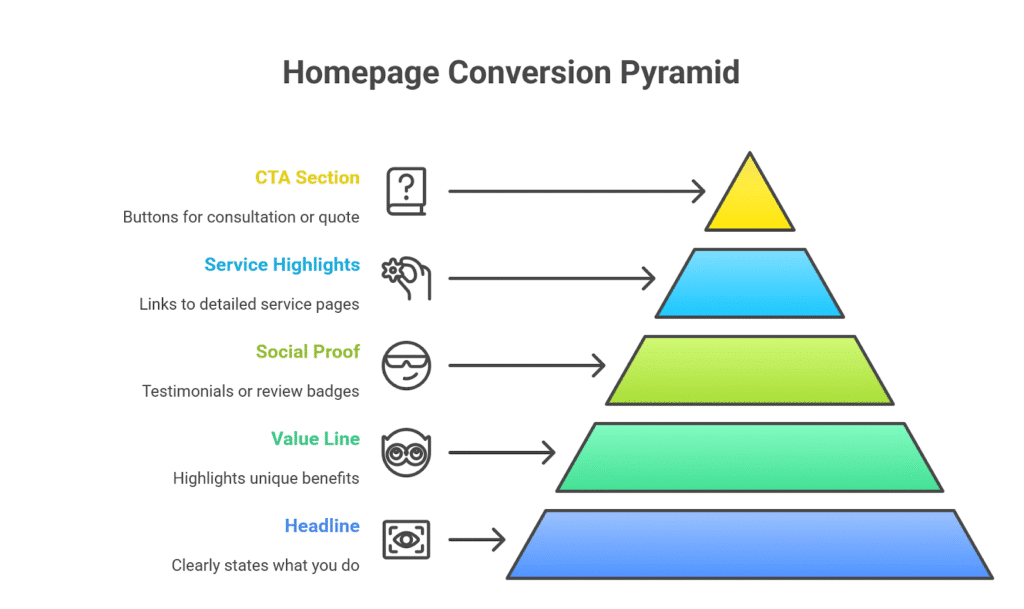
| A clear headline that states what you do and for whom | Grabs attention and sets expectations fast. |
| Short paragraphs describing services and advisory options | Helps potential clients see value quickly. |
| Testimonials and case studies | Proves your credibility to new visitors. |
| Lead capture form with a strong CTA | Turns traffic into high-quality leads. |
Your Next Step: Review your homepage today. If visitors can’t tell within five seconds what you offer and why you’re different, rewrite your headline and CTA.
Week 3: Lead Capture & Follow-Up Workflow
Getting a lead is only half the battle. Following up consistently turns leads into clients.
Here’s a simple workflow:
- Add a contact form on every important page.
- Connect the form to a CRM or email tool like HubSpot or Mailchimp.
- Set an automatic thank-you email with a short message and a helpful resource (e.g., “Top 5 Tax Mistakes Small Businesses Make”).
- Schedule a personal follow-up within 24–48 hours.
Your Next Step: Pick one follow-up tool and create a welcome email today. Even one automated message can nurture new clients and build trust faster.
These quick wins build a strong foundation for your digital marketing strategy without burning hours or budget. Next, you’ll learn how to drive more targeted traffic to your accounting website.
How Can My Accounting Firm Drive Targeted Traffic to Its Website?
Once your foundation is solid, it’s time to bring the right people to your site, not just anyone, but your ideal clients. Traffic only matters if it turns into conversations, consultations, or paying clients. That’s why smart accounting firm marketing focuses on targeted visibility, not just clicks.
Keyword & Persona Mapping
You can’t rank for everything, so start with focus. Identify what your ideal customers actually search for.
| Client Type | What They Search For | Sample Keywords |
| Small business owners | “affordable small business CPA,” “bookkeeping services near me” | bookkeeping, payroll, tax prep |
| Advisory clients | “fractional CFO services,” “strategic financial planning” | advisory services, CFO, business planning |
| Individual taxpayers | “best tax accountant near me,” “IRS enrolled agent” | tax filing, enrolled agent, individual tax help |
Use these insights to update your website copy, meta tags, and individual web pages. Tools like Google Keyword Planner and Ubersuggest help you find related phrases and search intent.
Pro Tip: Incorporate your city or region into keywords, “CPA in San Jose” or “tax accountant Bay Area.” Local SEO makes it easier for search engines to match you with nearby clients.
Long-Tail Topic List
Instead of broad keywords like accounting firm, target specific, low-competition topics that speak to real pain points. Examples:
- “How to simplify bookkeeping for e-commerce stores”
- “What every startup should know before tax season”
- “How advisory services help small businesses grow faster”
Each of these can be turned into blog posts, short videos, or LinkedIn articles that build visibility across multiple marketing channels.
Content Repurposing System
A good digital marketing strategy saves time by reusing your best work. Here’s how you can repurpose educational content across platforms:
| Original Content | Repurpose As | Channel |
| Blog post on “Quarterly Tax Prep Tips” | Short LinkedIn carousel | Social media |
| Webinar on “Cash Flow Planning for Small Firms” | 2-minute YouTube clips or Reels | Video |
| Email newsletter about new tax laws | Website FAQ or blog update | Website |
This helps your firm stay top-of-mind while building organic traffic and trust through consistent marketing efforts.
Your Next Step
Set aside just two hours this week to outline and write one blog post that answers a common client question. Pick one audience segment (small business, individual, or advisory) and create one piece of content tailored to their needs. Focus on being helpful; that’s how content creation turns visitors into clients. Make it educational, short, and clear, then share it across your social media channels and email list.
The goal isn’t more traffic. It’s more right traffic , people who see your expertise and trust you enough to reach out.
Conversion & Trust Signals on Accounting Websites
You can have great traffic, but if visitors don’t trust you, they won’t convert. Most firms underestimate how much trust matters in accounting website marketing. When potential clients visit your site, they’re not just looking for services, they’re asking, “Can I trust you with my money?”
Which trust signals move the needle for CPAs?
Strong conversion and trust signals turn curious visitors into booked calls. Here’s what every CPA firm should include on its professional website:
| Trust Signal | Why It Works | Example |
| Client testimonials & reviews | Builds credibility and social proof | “Our firm saved $25K in taxes thanks to [Your Firm Name]” |
| Certifications & memberships | Reassures potential clients that you’re qualified | AICPA, EA, or state CPA society badges |
| Case studies or micro success stories | Shows measurable results for past clients | “Helped a local startup reduce payroll costs by 15%” |
| Compliance badges & data security icons | Tells visitors their financial data is safe | SSL certificate, privacy compliance notice |
| Clear CTAs | Guides visitors to take the next step | “Schedule a Free Consultation” button on every page |
High-growth firms know that trust equals conversion. Many firms see up to a 30–40% increase in leads after adding testimonials and better CTAs to key pages.
A/B Test Ideas
Even small tweaks can boost conversion rates. Try testing:
- Button colors and placement (e.g., “Get Started” vs. “Book Now”)
- Testimonial order , newer or more specific reviews on top often perform better
- Adding a live chat pop-up or chatbot for quick answers
- Headline versions focused on outcomes (“Grow Your Small Business with Smarter Accounting”)
These A/B tests use a scientific approach to find what works best for your target audience.
Compliance & Trust Snapshot
Accounting firms must also ensure their marketing activities meet all professional and legal standards. Always:
- Follow state accountancy board advertising rules.
- Avoid exaggerated promises (“Guaranteed tax savings”).
- Keep your privacy policy visible and updated.
- Display secure payment or encryption icons if applicable.
Compliance isn’t just about rules, it’s part of trust. Visitors notice when your firm operates with transparency and professionalism.
Your Next Step
Pick one trust signal, testimonials, badges, or CTAs, and update it today. Even a single strong testimonial can turn a hesitant visitor into a paying client. When visitors trust your website, they stop browsing competitors and start booking calls with you.
Review & Reputation Management for Accounting Firms
Happy clients are your best marketing channel. A consistent system for gathering and showcasing reviews builds credibility and drives new business, without extra ad spend.
Referrals and reviews remain two of the strongest ways to win new clients. When a potential customer searches for “CPA near me,” firms with a solid review profile usually show up higher in search results and get more calls.
Here’s how to turn client satisfaction into steady visibility:
1. Create a Simple Review-Ask Email
After completing a project or tax filing, send a short email:
Subject: Thank you, one quick favor
Hi [Client’s First Name],
It was great working with you on [service/project]. If you had a good experience, would you mind leaving a short review on Google? It helps other small businesses find us.
[Leave a Review Button]
Thanks again,
[Your Name]
Keep it casual and easy, your clients are busy, and convenience increases response rates.
2. Choose the Right Review Placement
Place top reviews:
- On your homepage for immediate trust.
- On service pages near CTAs.
- In Google Business Profile where prospective clients first find you.
Adding even 3–5 verified testimonials can lift conversions by 20–30%.
3. Set a Recurring Schedule
Build review collection into your routine:
| Task | Frequency | Responsible |
| Send review email | Weekly | Admin or marketing lead |
| Update website with new reviews | Monthly | Web manager |
| Respond to all reviews (positive or negative) | Ongoing | Firm owner or manager |
This consistent rhythm keeps your profile fresh and signals to search engines that your firm is active and trustworthy.
Your Next Step
Reach out to three satisfied clients today. Ask for honest feedback and permission to share it on your website. Turning their kind words into visible proof helps attract new prospective clients and strengthens your reputation over time.
The best marketing doesn’t always cost money, it comes from your happy clients telling others how much they trust your work.
Frequently Asked Questions
1. How to market your accounting services?
Market your accounting services by building a strong digital marketing strategy that includes a professional, SEO-optimized website, consistent content creation, and active engagement on social media channels like LinkedIn. Focus on educational content that answers client questions, optimize your Google Business Profile for local visibility, and run targeted Google Ads to reach business owners searching for accounting help. Combining SEO, email marketing, and online reviews creates steady visibility and high-quality leads.
2. How to get clients for accounting services online?
To attract clients online, your accounting website must clearly communicate your services, results, and trust signals. Use search engine optimization (SEO) to rank for niche keywords such as “small business CPA near me.” Offer free resources, like tax guides or webinars, to capture leads and nurture them through automated email campaigns. Encourage happy clients to leave reviews and referrals on Google and social platforms. Consistency across your marketing channels turns online visibility into steady new clients.
3. Why are so many CPAs quitting?
Many CPAs are leaving the profession due to long hours, slow adoption of technology, and limited flexibility in traditional firms. Firms that modernize, through automation, content marketing, and stronger client relationships, retain talent longer and attract professionals who want to balance meaningful work with manageable workloads.
Conclusion
Growing your accounting firm online doesn’t have to be complicated. When you focus on measurable actions, like optimizing your Google Business Profile, publishing educational content, and tracking key metrics, you build steady visibility and trust with the right clients. Every improvement compounds over time, turning your accounting website into a reliable source of qualified leads instead of a static brochure.
At Ventnor Web Agency, we specialize in helping busy accountants turn their websites into client-generating tools. Our team designs clean, fast and SEO-optimized websites built to attract ideal clients and convert them into paying customers, all without adding more to your workload.
If you’re ready to elevate your online presence and stop losing leads to competitors, contact Ventnor Web Agency today. We’ll help you build a professional website that works as hard as you do.