
TL;DR
- A CPA firm’s website is often the first stop prospects make to judge professionalism, credibility, and fit, not just a lead generator.
- Many accounting websites look nice but fail because they don’t address prospects’ real questions (e.g., trust, expertise, service clarity).
- The goal isn’t more leads, it’s better-fit clients who are ready to engage.
- Effective CPA sites act as a trust filter, making the right visitors feel confident and guiding away the wrong ones.
- Key elements of a strong CPA website include:
- Clear explanations of services and who the firm serves.
- Trust signals like client proof and professional details (not just generic claims).
- Logical, easy navigation, especially on mobile (mobile-first design).
- Visible calls-to-action that guide visitors to the next step.
- Proper SEO, security features, and compliance basics to support visibility and trust.
- A redesign should be purposeful, improve trust, clarity & SEO, not just look more modern.
If you’re a CPA, your website is often the first place people check before they contact your firm. Even when a client is referred to you, they still visit your site to decide if you feel professional, credible, and worth their time. Your website acts as a digital representation of your company, showcasing its identity, values, and trustworthiness to potential clients. That’s why CPA website design is not just about looks. It’s about trust, clarity, and fit.
A strong accounting website helps your accounting firm show expertise, explain services clearly, and support your online reputation. It also helps clients on mobile devices, where many users now search for accountants and make decisions. According to research, more than half of all searches now happen on mobile, which makes mobile-first websites a must, not a nice-to-have.
This guide explains how website design should work for accounting, why many sites fail, and how to think about redesign decisions without wasting time or money.
Why Most CPA Website Designs Fail to Convert Clients
Many CPA websites look clean and modern, yet they still fail to bring in the right clients. The problem usually isn’t effort or budget. It’s that the website design is solving the wrong problem.
Most accounting firms are told to “add more marketing,” “get more traffic,” or “generate more leads.” But for most accountants, especially those who grow through referrals, that advice misses the point. Your site is not being judged like an online store. It’s being judged as proof that your accounting practice is real, capable, and safe to work with.
A weak accounting website design creates doubt. Doubt slows decisions. And doubt is why visitors leave without calling, booking, or becoming new clients.
Why a Good-Looking CPA Website Still Doesn’t Get Clients
A good-looking site does not automatically build trust. Many websites for accountants focus on visuals, templates, or trendy layouts. They may look polished, but they fail to answer the real questions clients have in their heads:
- “Do they handle firms like mine?”
- “Can I trust them with sensitive financial data?”
- “Are they experienced during tax season and beyond?”
- “What proof do they have that they’ve actually helped clients like me?”
Research from Stanford shows that 75% of users judge a business’s credibility based on its website design, but credibility is about more than style, it’s about clarity and substance.
If your accounting website looks nice but does not clearly explain your services, your process, or your expertise, most people will move on. This is especially true for CPA firms, where trust matters more than clever visuals.
The Most Common CPA Website Design Mistake: Solving the Wrong Problem
The most common mistake in CPA website design is treating the site like a lead machine instead of a trust filter. Most accountants do not need more random leads. They need:
- Better-fit clients
- Fewer unqualified inquiries
- Less time wasted on the wrong conversations
A website built only for generating leads often attracts the wrong people. This hurts your time, your team, and your online reputation.
Here’s a simple way to see the difference:
| Focus of the Website | What Usually Happens |
| “Get more leads” | More emails, lower quality, more time wasted |
| “Builds trust and screens for fit” | Fewer inquiries, better clients, faster decisions |
For an accounting firm, the job of the website is to confirm that you are professional, qualified, and a good match. When that job is done well, conversions happen naturally.
How Prospects Choose a CPA Firm Online
Most people don’t choose a CPA the moment they hear your name. Even when a referral comes from a trusted source, the next step almost always happens online. They search your CPA firm on Google, visit your website, and quietly decide if you feel like the right fit.
This is where CPA website design plays a critical role. Your accounting website is not replacing referrals. It is validating them. If your site creates doubt, the referral often goes nowhere.
Research from BrightLocal shows that 87% of consumers read online information and reviews about a business before contacting it, even when referred. For accountants, this means your site must support the decision your prospect is already leaning toward or give them a reason to walk away.
The CPA Website’s Role in the Client Decision Process
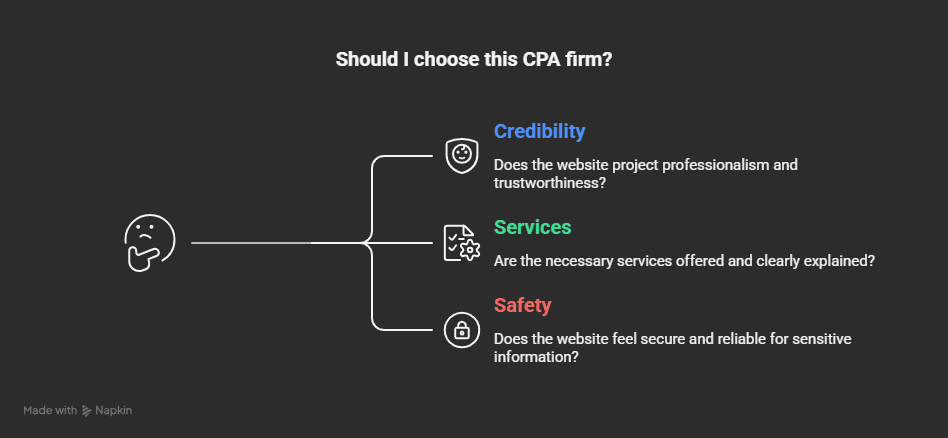
Your website sits in the middle of the decision, not at the start and not at the end. It helps prospects answer three basic questions:
- Is this firm credible?
- Do they offer the services I need?
- Do they feel safe to work with?
A professional website supports your brand, your online reputation, and your visibility in search engines. Google has confirmed that clear structure, helpful content, and mobile usability are key signals for ranking and user trust.
For certified public accountants, this matters even more because clients are trusting you with sensitive financial and tax information.
The Real Conversion Goal of a CPA Website (It’s Not More Leads)
For most accounting firms, the goal of a CPA website isn’t to bring in as many leads as possible. The real goal is to bring in the right clients. That difference matters more than many accountants realize.
Most firms are already busy, especially during tax season. More inquiries don’t always lead to more new business. In many cases, they lead to more emails, more calls, and more time spent on people who were never a good fit in the first place.
That’s where accounting website design needs a reset.
Why More Accounting Website Leads Often Create Worse Outcomes
When a website is built only to generate leads, it attracts everyone. That often means people who are just comparing prices, people asking about services you don’t offer, and people who aren’t ready to commit yet.
Even though these inquiries rarely turn into clients, each one still takes time to read, reply to, or screen. Over time, that extra effort adds up and pulls attention away from the clients and work that matter most.
For a CPA firm, this often shows up as more screening calls and less time for the clients you already serve. A well-designed accounting website helps avoid this by setting clear expectations before someone reaches out.
How CPA Website Design Attracts or Repels the Right Clients
Your website is always sending signals, even when you don’t notice them. The way your services are explained, how pages are structured, and the words you choose quietly tell visitors who your firm is meant for, and who it isn’t. Clear service pages and simple explanations tend to attract clients who value expertise and long-term relationships.
At the same time, they naturally push away people who are only looking for the lowest price. For websites for accountants, this usually means:
- clearly listing services
- explaining who you work best with
- showing real experience instead of vague claims
Why High-Converting CPA Websites Filter Prospects, Not Just Convert Them
High-performing accounting websites don’t try to persuade everyone. Instead, they help people decide quickly whether your firm is the right match.
When a website is clear about who it’s for and how it works, fewer people reach out, but the conversations are better from the start. Prospects come in with realistic expectations, clearer questions, and a better understanding of your services. That leads to smoother discussions and stronger close rates.
For CPA website design, success isn’t about traffic numbers. It’s about whether your site helps the right clients feel confident taking the next step.
What Builds Trust on CPA Websites (And What Actively Undermines It)
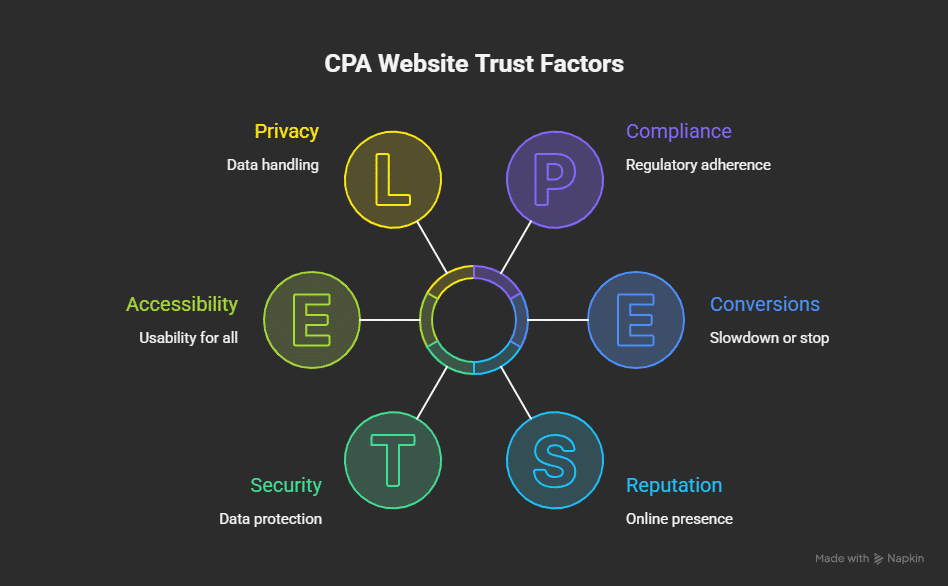
Trust is the real currency of any CPA website. People are not just hiring an accounting firm for a service. They are trusting you with tax records, financial data, and long-term decisions. If your website design does not support that trust, conversions slow down or stop completely.
A professional accounting website design helps your firm appear in search, supports your online reputation, and reassures visitors that you take their information seriously. Google has confirmed that trust, usability, and helpful content all play a role in how sites perform in search engines.
Why Trust Claims Don’t Work on Accounting Firm Websites
Saying “trusted,” “experienced,” or “reliable” doesn’t convince anyone on its own. Most CPA firms use the same words, so visitors tend to skim right past them.
What people actually look for is proof. A professional website should show what you’ve done for clients, not just state what you believe about yourself. When visitors can see how you work, who you help, and the kind of problems you solve, trust starts to build on its own.
Clear service pages, real examples, and plain language all help answer the question prospects care about most: “Have they handled situations like mine before?”
Professional Design vs Actual Credibility: What Clients Respond To
A clean look helps, but credibility goes deeper than visuals.
Strong accounting web design combines:
- Clear explanations of services
- Logical, easy-to-follow layouts
- Simple navigation across all browsers and mobile devices
- Consistent branding that feels steady and professional, not flashy or trendy
- Clear next steps, so clients always know what to do after reading a page
This matters because many users skim your site on phones. A mobile-first website design ensures your site feels consistent and usable whether someone visits from a laptop, tablet, or smartphone.
All modern builders now support mobile-first websites, which makes this a baseline requirement, not a bonus.
Compliance, Security, and Accessibility: Expected, Not Differentiating
Security and compliance are not optional for certified public accountants.
A trustworthy CPA website should include:
- SSL certificates for secure data transmission
- Visible privacy policies in the footer
- Compliance and association badges, such as AICPA credentials
Google confirms that HTTPS is a ranking signal and a trust requirement for modern websites.
Accessibility also matters. High-contrast modes, readable fonts, and keyboard-friendly navigation help meet accessibility standards and improve usability for many users. These elements do not make your firm stand out, but missing them can seriously hurt trust.
How to Evaluate Your CPA Website Without Being a Designer
You don’t need to be a designer or marketer to know if your CPA website is helping your firm or holding it back. You just need to look at it the way a client does.
Most people spend only a few seconds deciding whether to stay on a website or leave. That means your accounting website must communicate trust, clarity, and value very quickly.
What Your CPA Website Should Communicate in the First 30 Seconds
When someone lands on your website, they should immediately understand who you serve, what services you offer, and why they can trust your CPA firm.
A strong, professional website clearly presents your core services, such as tax preparation, audit, and advisory services, so visitors don’t have to guess or search for answers. Each service should have its own dedicated page that explains your approach, outlines required documents, and addresses common questions. This builds confidence, educates potential clients, and removes friction in the decision-making process.
If visitors have to dig for basic information, they’re far more likely to leave and look elsewhere.
Signs Your Accounting Website Is Attracting the Wrong Clients
A weak accounting website design often attracts people who are not a good fit. This usually shows up as:
- Price-only inquiries
- Requests for services you don’t offer
- Low-quality leads that go nowhere
A well-built CPA website uses clear language, strong positioning, and visible calls to action (CTAs) to guide the right clients forward. Every page should have a clear next step, whether that’s booking an appointment, using contact forms, or downloading a guide.
Marketing research shows that clear CTAs significantly improve conversion rates.
Red Flags That Predict a Failed or Disappointing Website Redesign
Many accounting firms invest in a new website but see little return. These red flags often explain why:
| Red Flag | Why It Hurts |
| No mobile-first design | Many users search on phones and tablets |
| No SSL or security signals | Reduces trust immediately |
| No clear services pages | Creates confusion |
| Generic templates with no customization | Fails to show expertise |
| No SEO or content plan | Site stays invisible |
All modern builders provide mobile-responsive templates for accounting websites. A mobile-responsive design is critical. Google confirms that mobile usability is a ranking factor, and most searches now happen on mobile.
Why CPA Website Redesigns Fail (And Why This Is So Common)
Many accounting firms invest in a redesign hoping for better results, only to feel disappointed months later. The website looks nicer, but inquiries don’t improve, or the clients coming in are still the wrong fit. This is a common outcome in accounting and it usually has nothing to do with the designer’s skill.
Most redesigns fail because there was no clear plan for how the site should support marketing, trust, and lead flow.
The Most Common Reasons CPA Website Projects Stall or Disappoint
Redesigns often break down for the same reasons:
- The goal was “a new look,” not better results
- SEO and lead generation were added too late
- Content was rushed or reused instead of written fresh
- Mobile users were treated as an afterthought
If your accounting website design does not work well on phones and tablets, you lose visibility and trust fast. This matters because many users search for accountants on mobile devices first.
When a CPA Website Redesign Is Worth the Investment (And When It Isn’t)
A CPA website redesign can help your firm grow, but only in the right situations. Investing in professional design services ensures your website is not only visually appealing but also strategically built to support your business objectives.
Many accountants spend money on a new website when the real issue is not design at all. By partnering with a design service provider, you can align your website with your firm’s goals and branding, making sure a redesign will actually move the needle for your business.
Situations Where Redesigning a CPA Website Makes Sense
A redesign is worth it when your website can no longer support trust, visibility, or growth.
It usually makes sense if:
- Your site is not mobile-first and is hard to use on phones and tablets
- Your services are unclear or buried, making it hard for clients to understand what you do
- Your site does not support SEO, so you don’t appear well in search engines
- You can’t easily manage content, leads, or updates
Choosing a complete solution that covers all aspects of website design, SEO, and ongoing management ensures your new site will fully support your firm’s goals.
Strong accounting website design is clean, modern, mobile-first, and SEO-friendly. When those basics are missing, redesigning is often the right move.
When an Accounting Website Redesign Won’t Improve Results
A redesign is usually not the answer if:
- Your site already works well on mobile and loads quickly
- Your content is thin, outdated, or copied
- There is no plan for marketing, SEO, or lead follow-up
Without a clear strategy, even the best designers or custom build projects won’t deliver results. If your accounting website is not publishing useful updates, such as tax law changes or planning tips, it will struggle to attract traffic and new clients, no matter how modern it looks.
Common CPA Website Design Myths That Waste Time and Money
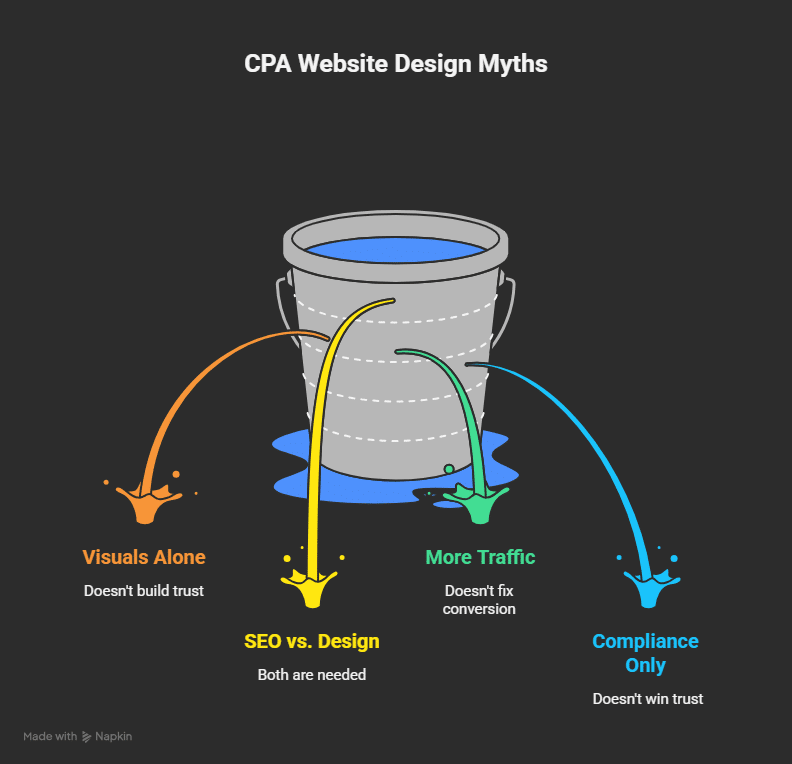
Many accountants make website decisions based on advice that sounds right but doesn’t work in practice. Most of these ideas come from generic marketing talk that doesn’t reflect how clients actually choose a CPA firm. Clearing up these myths helps you stop wasting time and focus on what really moves your business forward.
1. A Professional-Looking CPA Website Automatically Builds Trust
A clean design helps, but it doesn’t create trust on its own. Clients are not just judging how your site looks. They are looking for signs that you know what you’re doing and that you’ve helped people like them before.
They want to quickly understand what services you offer, who you work with, and what experience you bring to the table. That’s why strong accounting website design needs to show the real “hero” in your firm, your expertise, results, and client work, not just polished visuals.
2. SEO and Website Design for CPAs Are the Same Thing
SEO and design work together, but they are not the same thing. SEO helps your accounting website show up in search engines. Design helps visitors feel confident once they arrive.
A good-looking site without SEO stays invisible. SEO without clear design and messaging brings traffic that doesn’t convert. Both need to be planned from the start.
3. More Traffic Will Fix a CPA Website That Doesn’t Convert
If your website is confusing, sending more people to it won’t help. It usually makes things worse. More traffic just means more visitors leaving without taking action.
A better approach is improving clarity, structure, and calls to action so the site can guide visitors toward the next step. HubSpot reports that businesses focusing on conversion improvement see stronger results than those chasing traffic alone.
4. Website Compliance Equals Client Confidence
Compliance is necessary, but it doesn’t win trust by itself. Your CPA website should have SSL security, privacy policies in the footer, and visible association or compliance badges. These reduce concern, but they don’t replace clear communication. Clients still want to understand your services, your process, and your experience.
Conclusion
CPA website design is not about trends or flashy visuals. It’s about helping the right people feel confident choosing your accounting firm. A strong accounting website builds trust, supports your online reputation, and makes it easy for good-fit clients to move forward, while a weak one creates doubt and attracts the wrong conversations.
The real job of your website is to help prospects decide if your firm is the right fit. That means clearly explaining your services, showing real expertise through original content, and using trust signals like credentials, security, and compliance. When your site is built with purpose and supported by a clear marketing and SEO plan, it becomes more than an online brochure, it becomes a tool that attracts better clients and supports long-term growth.
At Ventnor Web Agency, we design CPA and accounting firm websites that focus on clear messaging, mobile-first design, SEO-ready structure, and real credibility signals that help referrals convert, and prospects feel confident reaching out. If your website isn’t supporting your firm the way it should, let’s fix that, schedule a free consultation let’s help.